The complete guide
What is the 9x12 method?
The 9x12 method is a local advertising business: an operator sells space to several businesses on one shared postcard, arranges its mailing, and keeps the revenue left after all expenses.
By Dustin Myers · Sources and corrections
Last updated
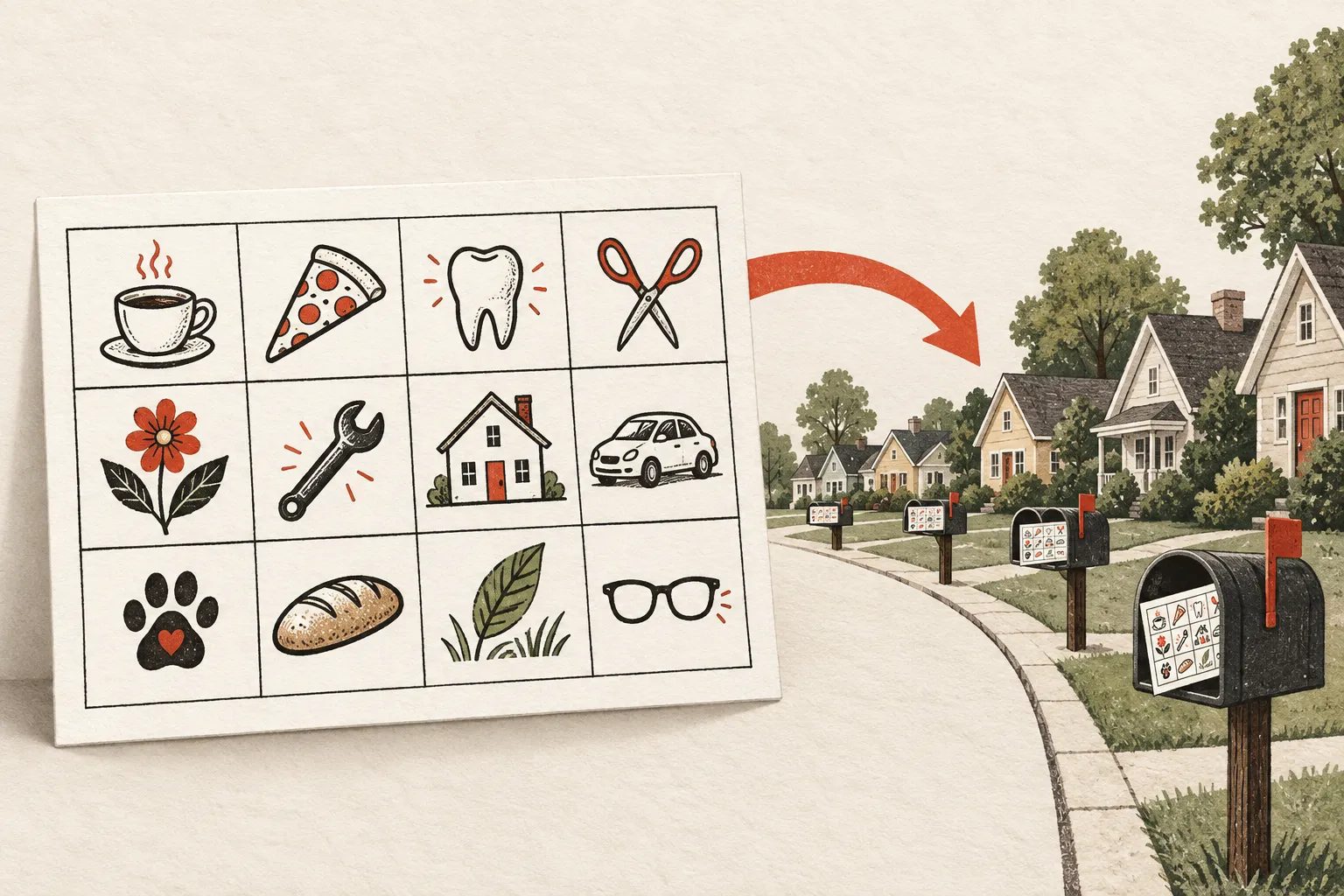
The operator sells the advertising, coordinates the artwork, collects payment, and arranges printing and delivery. The businesses buy space on the card; the residents receive it with their mail. With USPS Every Door Direct Mail (EDDM), the mailing is organized around carrier routes rather than a purchased list of named recipients.
The model in one paragraph
Choose an area that local advertisers serve, plan a shared postcard, and price its ad spots. Sell enough placements to support the budget, prepare the ads, get approvals, and arrange printing and mailing. Revenue comes from the advertisers. Profit is what remains after all expenses, including the cost of delivering the commitments you sold.
9x12 method, side hustle, community card or shared EDDM?
These terms describe different parts of the same workflow:
- 9x12 method
- The business model of organizing a shared advertising postcard.
- 9x12 side hustle
- Running that business around other work. See the side business guide.
- Community card
- The physical postcard carrying several local business ads.
- Co-op postcard advertising
- Advertisers sharing space and mailing costs.
- Shared EDDM
- A shared advertising piece delivered using USPS EDDM. See how it differs from solo EDDM.
- 9x12 Tools
- Software for the operator’s card, routes, prospecting and sales workflow.
The real math
The most useful calculation includes the possibility that a card does not fill. The table below uses our published advertised-price survey and a sourced printing/postage example. It does not establish what an average operator earns.
One mailing, worked through
- Mailed pieces
- 5,000
- Available spots
- 12
- Per sold spot
- $477
Illustration, not measured operator earnings. A 9x12 card, with every sold spot collected at the survey's advertised median. This is not a guaranteed selling price.
| Item | Amount |
|---|---|
| Printing input | $1,209 |
| Postage $0.26 per piece | $1,300 |
| Printing + postage Subtotal before other expenses | $2,509 |
| Spots sold | Collected revenue | After printing + postage only |
|---|---|---|
| 0 | $0 | -$2,509 |
| 5 | $2,385 | -$124 |
| 6 | $2,862 | $353 |
| 8 | $3,816 | $1,307 |
| 12 | $5,724 | $3,215 |
6 collected spots cover printing and postage in this example.
Full business break-even also includes design, payment processing, software, fulfillment, shipping, refunds and your time; taxes affect what you keep. A sold-out card's remainder is not net profit or take-home pay.
The printing and postage subtotal stays the same as spots sell in this example. Other costs can change with sales, and unsold spots can leave you below break-even. Do not treat money collected for an undelivered mailing as money available to spend personally.
Why the postcard is 9x12
A landscape 9x12 layout provides space for several readable offers. A smaller 6x11 layout can be useful when fewer or smaller placements suit the campaign. Neither size makes an offer effective by itself.
Response. Readability, the offer and the audience matter. We do not have a controlled comparison showing that this format produces a particular response rate or outperforms email.
Postage. Qualifying 9x12 and 6x11 pieces use the same EDDM Retail per-piece postage. Lower printing cost on a smaller card should not be described as a lower postal rate. Check your actual design with USPS and your printer before ordering; the template guide covers the layout files.
How EDDM actually works
USPS EDDM Retail lets you select carrier routes without buying a named mailing list. USPS currently describes Retail mailings as at least 200 and up to 5,000 pieces per day per ZIP Code, with no special mailing permit required. A larger plan needs to account for that limit or use the appropriate bulk-mail service.
- Choose routes and verify the delivery count. Decide whether your selection includes residential deliveries only or also business deliveries.
- Order enough cards. A hypothetical route total of 4,974 deliveries fits a 5,000-card print run; the extra 26 are available for samples.
- Complete the USPS order. Obtain its payment record, forms and facing slips.
- Prepare by route. Follow the current USPS bundle requirements and record the actual count on each facing slip. See the bundle examples.
- Use the designated postal unit. Confirm the destination and preparation with USPS or your mailing provider.
The USPS EDDM guide is the authority for postal requirements. Saving routes in 9x12 Tools plans the campaign; complete the mailing order and paperwork with USPS or your provider.
Pricing your spots
Start with a current print quote, actual route counts and a complete budget. Then compare the placement you intend to sell with what businesses in that area can use: audience, ad size, offer, mailing frequency and category overlap.
The pricing survey is a reference for advertised prices on one platform. It does not tell you the price a particular advertiser will accept. State whether the price covers one mailing or a recurring commitment, and what design work is included.
Who buys a spot
Look for businesses whose service area overlaps the routes: home services, dental practices, restaurants, salons, auto repair and other neighborhood businesses. Category alone does not establish fit. Ask whether the offer, capacity and audience match before pitching a placement.
In 9x12 Tools, saving EDDM routes automatically generates, scores and ranks local business prospects. Review the reasons behind the ranking, qualify the businesses yourself, and log your calls and visits. The software does not make the outreach or the sale for you.
For the conversations that follow, use the guide to selling postcard ad space. It covers qualifying a business, explaining the placement and following up.
The part that kills most operators
We built a campaign-site product, and nearly two years of watching operators use it changed our priorities. The recurring problems were filling the card and collecting for it. A site alone does not solve either problem.
A useful workflow connects a priced spot, the invitation, payment, the sold status and advertiser approval. Keep a record of who committed, who paid, what you owe them and whether their ad is approved. A verbal yes is not a collected sale, and a collected sale is not a delivered mailing.
How to run your first drop this month
Treat this as an order of operations, not a promise of a monthly launch:
- Pick a route area, obtain print quotes and set a realistic budget.
- Build a legible card with priced spots. Saving routes in 9x12 Tools creates the ranked prospect list and the campaign generates its website preview.
- Qualify businesses and work through outreach and follow-ups. Recalculate break-even using the amounts you will actually collect.
- Agree on scope, deadlines and what happens if the mailing cannot proceed. Collect payments and keep the record attached to each placement.
- Prepare the ads and get advertiser approval before ordering print.
- Complete mailing preparation, retain delivery documentation and review results with advertisers before proposing another drop.
Your first planning task is to choose an area, save the routes and price a readable card. The campaign setup tutorial walks through that process. Building, route selection, pricing and previewing are free; publishing so the campaign can sell and enabling advertiser checkout require a paid plan.
Choosing a CRM for the 9x12 method
Start with the shared-postcard software buying guide if you are choosing between separate tools and a connected campaign platform. It covers prospects, routes, spot payments and proof approvals, with questions to test in a demo.
Choose around the work you need to remember: who to contact next, what you promised, who paid and which artwork is approved. A contact list covers only part of that workflow. In 9x12 Tools, the work queue and searchable Lead Book connect outreach and follow-ups with invitations and linked sales. See the CRM and advertiser lead workflow with app screenshots.
If you are comparing named products, start with 9x12 Method CRM or 9x12 CRM. They are separate products, and the comparisons cover their strengths, published features and the questions to test in a trial.
What to do next
Use the startup guide to plan the work, the community card guide to explain the purchase to an advertiser, and the side hustle guide to consider whether you have time for it.
9x12 Tools is free for building the card, selecting routes, pricing and previewing. Publishing so a campaign can sell, advertiser checkout and connecting a domain require a paid plan. See pricing. Print and mail fulfillment is on the roadmap and is not available through the platform today.
Sources and scope
- USPS: Every Door Direct Mail — Primary source for Retail postage, mailing limits, route selection and preparation. Checked September 13, 2026; verify again before ordering a mailing.
- 9x12 Tools Community Card Pricing Survey (2026) — Our published snapshot of advertised prices on 76 operator sites across 81 markets. It does not measure completed sales, profit or success rates; the underlying records are not public.
- Printing and postage: the worked cost example — The site's published printing and postage inputs, with printer references. These are budgeting examples, not a current quote or a complete operating budget.
Published by 9x12 Tools, which sells software for community card operators. Read our sources and corrections policy.
Straight answers
Before you ask.
Still not covered? Ask directly and you will get a reply from a person who runs these campaigns.
Is the 9x12 method a business model or a course?
Here, the 9x12 method means selling advertising space on a shared postcard. Courses and communities may teach that business model. 9x12 Tools sells operator software; it is independent of the similarly named company The 9x12 Method LLC.
How much does it cost to start?
Build a budget from your printer quote, selected USPS routes, software, design, payment processing and fulfillment. Collecting from advertisers before printing can help fund the mailing, but it does not remove costs or the obligation to deliver. The worked example on this page separates printing and postage from other expenses.
Can you lose money with the 9x12 method?
Yes. A mailing can cost more than you collect if too few spots sell, prices do not cover the full budget, or expenses increase. Before committing to production, compare collected payments with all remaining costs and agree with advertisers what happens if the mailing cannot proceed.
Why use a 9x12 postcard?
The format gives several advertisers room on one piece. A 9x12 design still needs to meet USPS requirements for dimensions, thickness, weight and preparation; the size alone is not a guarantee of acceptance or response.
How many spots should a card have?
Choose a grid that keeps each offer readable at the printed size and supports your budget. This guide uses twelve spots as an illustration. Spot count and sell-through are decisions and outcomes, not guaranteed averages.
Do advertisers renew?
Some may, but we have not published a measured renewal rate. Review the advertiser's offer, tracked activity and reported results before proposing another mailing. A QR scan alone does not establish a sale.
What is the difference between 9x12 and 6x11?
The card dimensions and available ad space differ. Printing prices can differ, but qualifying pieces mailed through the same EDDM Retail service have the same per-piece postage. Compare actual quotes and legibility for your layout.
Build your first drop before paying for software.
Build the card, pick the routes and price the spots for free. A plan starts when you publish and switch on checkout.