Inbound beats outbound every time
There’s a version of this business where you spend your days cold-calling dentists and landscapers, leaving voicemails, sending follow-up emails, and hoping someone picks up. A lot of operators are living that version right now.
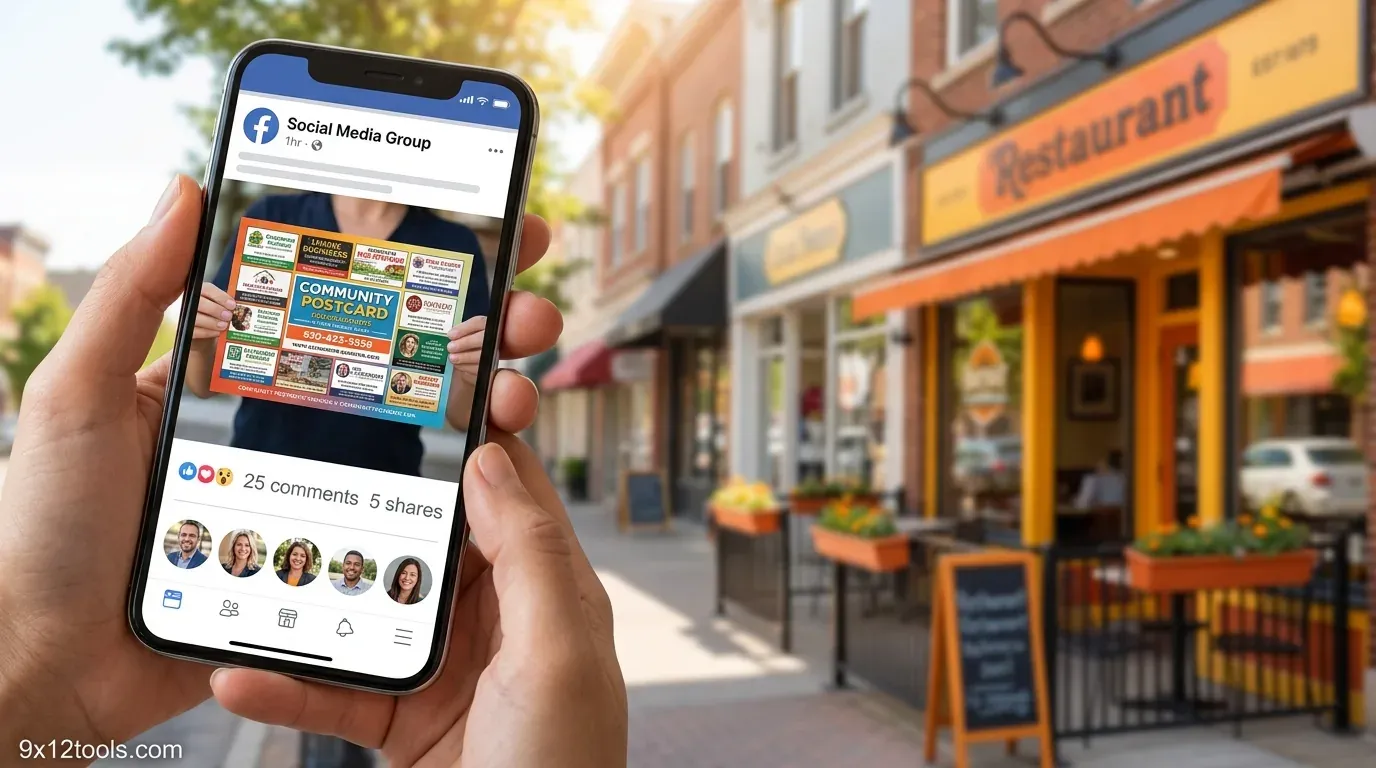
And then there’s a version where you post something in a Facebook group and wake up to 25 businesses who reached out to you.
Local Facebook business groups are an underused prospecting channel, and the difference between one that produces replies and one that produces nothing is entirely in how the post is built. Not posting and hoping — there is a specific shape to it.
The one thing most operators skip: photos
A tactic that keeps coming up in EDDM circles is simple but easy to overlook. When you post in a Facebook business group, include actual photos of your mailer.
Not a description of it. Not a link to your website. Photos — ideally two kinds:
- A sample of the printed card itself (filled with real ads, or a mockup showing how it looks)
- A photo of bundled mailers — the stacked trays of postcards ready to go to the post office
What happens without photos is that businesses read your post and try to mentally picture what you’re selling. Most of them don’t. They scroll past.
What happens with photos is different. They can see the physical product. They can see it’s real, that it goes out in volume, and that it looks professional. The “I don’t really understand what I’m buying” objection disappears instantly.
Operators who are filling cards fast tend to have this in common — they make the product visible before the conversation even starts.
You’re not selling. You’re connecting.
The other piece is framing. Facebook business groups are communities. Members are protective of them. If your post reads like a sales pitch, it gets ignored at best, reported at worst.
What’s working right now for a lot of people in this space is positioning themselves as a community connector, not a marketer. You’re organizing something local — a shared postcard that goes to 5,000 homes in the area, with a limited number of local businesses represented. You’re not trying to sell anyone anything. You’re letting people know the opportunity exists.
That shift in framing changes how people read your post. And adding a family photo — just you and your family, nothing sales-y — reinforces it. People buy from people they feel connected to. A family photo does quiet but real work.
What to do with the people who respond
Here’s where operators leave money on the table. They post, get a wave of “interested!” comments or DMs, and then fumble the follow-through.
I’ve been hearing from operators who found that email follow-ups after a Facebook interaction mostly went cold. What’s working better is switching to phone after the Facebook touchpoint. The FB post creates the warm introduction — it takes away the cold-call awkwardness because they already know what you’re about. The call just moves it to a close.
The workflow that makes this work is unglamorous: post in local business groups, note which businesses engage or comment, then call them. The post is not the close — it is a way of finding out who is warm before you dial, which is the expensive part of prospecting.
The sequence matters. Facebook first (broad reach, visual, community framing), phone second (personal, closes). Neither works as well alone.
Where to find the groups
Search Facebook for your city name or county name plus terms like “business,” “entrepreneurs,” “local businesses,” or “small business owners.” Most mid-size markets have several active groups. Strip mall owners, home services, retail — they’re all in there.
You’re looking for groups where local business owners post, not just consumer groups. The right groups have owners promoting their services, asking for referrals, and talking shop. Those are your people.
Post consistently over a few days across multiple groups. Don’t post the same exact text everywhere — vary it slightly so it feels native to each community.
The simple formula
To summarize what’s actually working:
- Post in local Facebook business groups (not just consumer groups)
- Include a photo of the printed card and a photo of bundled mail trays
- Add a family photo or personal touch — community connector, not salesman
- Frame it as a limited opportunity for local businesses, not a pitch
- Follow up by phone with anyone who engages
That’s it. No cold list. No email software. Just a few posts and a phone call to anyone who raises their hand.
The advantage is not volume, it is temperature: a business owner who commented on your post is a materially easier call than one you found on a map.
Inbound leads are the easy half. The half that decides whether the card fills is what happens after somebody raises their hand — the follow-up, and being able to take their money the moment they say yes rather than emailing an invoice that evening.
We don’t sell training, and we’re not going to. If you want a room of operators actively running cards — swapping scripts, posting what’s working this month — the one we take part in is the Print & Postal Profit Lab — a free Skool community run by Will Bradwell. It isn’t ours, we don’t run it, and the link is a referral link.
Read next
Who Should You Call First? How the Lead List Builds and Ranks Itself
Save your EDDM routes and the businesses in your mail area are already found, scored and ordered. Here is exactly where they come from, what the grade means, and where it should be overruled.
Read the guide