Cold outreach isn’t the only way to fill a card
Most operators starting out think filling a community card is all cold emails, door knocking, and phone calls. Those work, and they remain the job. But there is a paid tactic that costs almost nothing and is worth running alongside them.
A $7-a-day Instagram boost.
That is not a typo. Seven dollars a day for seven days is a $49 total budget — small enough that one reply pays for it several times over, which is the entire reason to try it.
The setup is specific, though. It’s not just boosting any post and hoping. Here’s what’s actually working.
Step one: make a vertical video of your physical card
What’s working right now for a lot of people in this space is using a physical mockup as the video subject. Not a flyer, not a screenshot of your website, not a stock photo of a mailbox. The actual printed card — or a high-quality mockup that looks like one.
Get a vertical printed sample (or a foam board mockup) and record a short video of it. Show the front, show the back, hold it up, walk through what it looks like. Vertical format performs best in Instagram feeds and Reels because it fills the screen on a phone, and that’s where your prospects are scrolling.
The video doesn’t need to be polished. 30-60 seconds is plenty. The point is to show the physical product in motion. When a business owner scrolls past and sees what looks like a real mailer in someone’s hands, they stop. It feels real in a way that graphics don’t.
Why the caption matters as much as the video
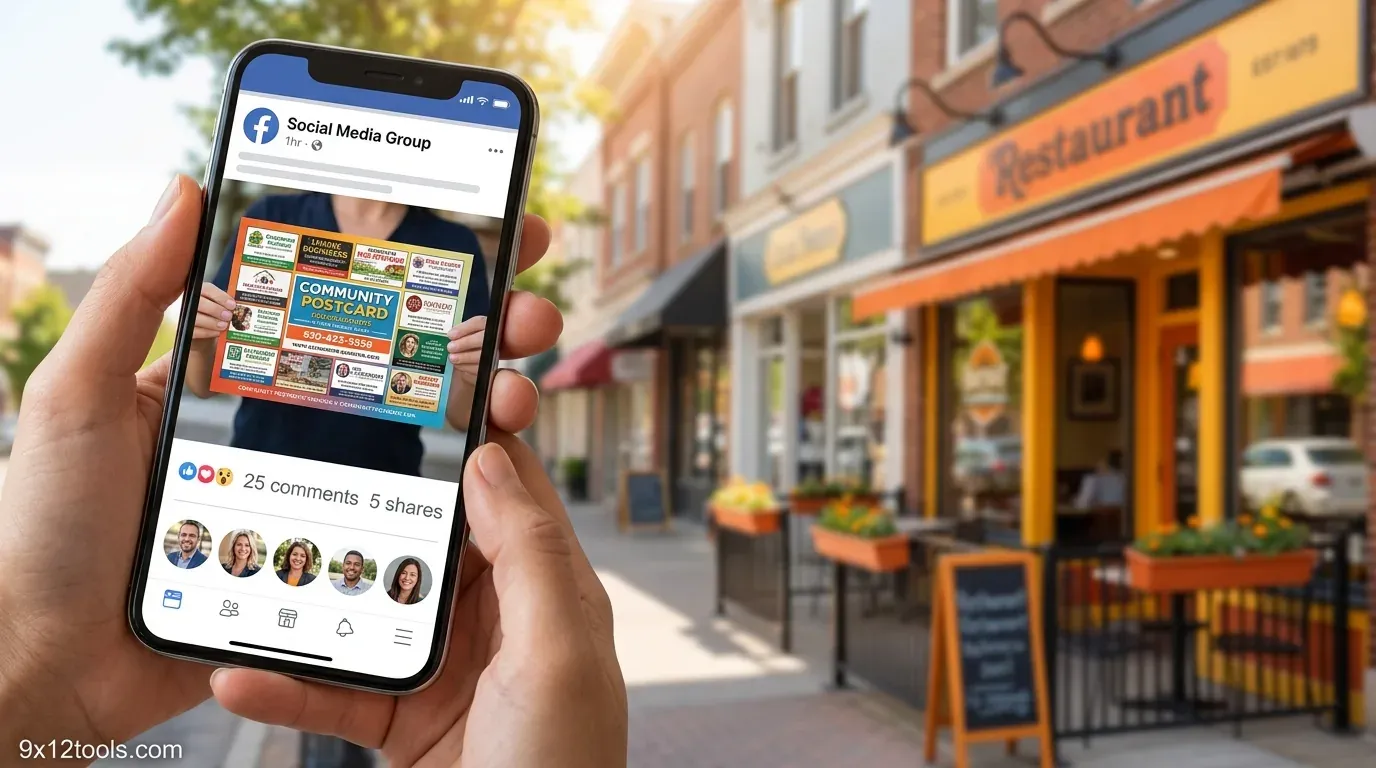
A tactic that keeps coming up in EDDM circles is leading the caption with the category angle. Something like: “I’m filling a community postcard going to [X,000] homes in [your area]. Looking for one roofer, one HVAC company, and a few other local businesses who want to be the only one from their category on this card.”
The word “only” does a lot of work. This isn’t a newspaper with 12 plumbers listed. It’s one plumber, one dentist, one landscaper. That exclusivity is your hook, and it reads well in a short caption before someone decides whether to reach out.
End the caption with a clear call to action: “DM me your category to see if it’s still open.” Low friction. They don’t have to schedule a call or visit a website — they just reply.
Who to target and why roofers buy first
I’ve been hearing from operators who run these boosts and notice that roofers, HVAC companies, and contractors consistently respond faster than restaurants or retail. The reason makes sense when you think about it: home service businesses have been sold on local advertising their whole career. They know what a mailer is, they understand neighborhood targeting, and they’ve done the math on what one new job is worth to them.
A roofer’s average job is worth several thousand dollars, so the arithmetic on a $400-600 spot only has to work once for them to be interested — and they can do that arithmetic themselves without you asserting a multiple you cannot verify. They have heard this pitch before and they know the model can work. What they do not know is whether your specific card reaches their area, and that is the only thing you need to tell them.
When boosting, target locally — set your radius tight around the zip codes your card will mail into. You want business owners and self-employed people in those areas to see it. Instagram’s targeting isn’t perfect, but at $7/day over a week, you’re not trying to run a precision campaign. You’re trying to put a visual of a real physical mailer in front of people who already want local advertising exposure.
What happens after the DM
The boost gets the conversation started. From there, the process is the same as any warm lead: confirm their category is open, send them a simple price and placement overview, and ask for a deposit to hold their spot.
What’s different about inbound from a paid boost versus cold outreach is the frame. They reached out to you. They already know what the card is. You’re not explaining the concept from scratch — you’re answering questions and closing. That’s a much easier conversation.
One thing worth noting: the operators seeing the best results from this run the boost while they’re doing their regular outreach, not instead of it. The boost brings inbound. Email and calls still work the outbound pipeline. The two together fill cards faster than either channel alone.
Once spots start selling, the operational side matters just as much as the outreach — collecting payments, routing artwork, and keeping your drop organized. Set up a simple system for that part of the workflow early so you can focus on filling cards rather than chasing invoices.
The full setup, start to finish
To recap what’s working:
- Get or make a vertical physical mockup of your card
- Record a short vertical video (30-60 seconds) showing the front and back
- Post it to Instagram and boost it for $7/day for 7 days ($49 total)
- Target the zip codes your card will mail into — business owners and self-employed
- Caption leads with the exclusivity angle and ends with “DM me your category”
- Prioritize roofers, HVAC, and contractors in your outreach — they respond fastest
For a $49 spend, the risk is negligible. If you get one conversation that converts, you’ve covered the ad spend 8-10 times over. We have no data on how often it works, so treat it as a cheap experiment rather than a plan.
If you want to go deeper
The $7/day boost is just one tactic. What fills cards faster than any single channel is stacking approaches — paid boosts for inbound, Facebook groups for organic, and consistent follow-up for the prospects who went quiet. Operators who are genuinely active across those three channels are the ones selling out cards quickly and running repeat drops.
A $49 boost that produces a DM has done its job. What happens next is on you: the follow-up, and closing the gap between “I’ll take it” and the money actually arriving.
We don’t sell training, and we’re not going to. If you want a room of operators actively running cards — swapping scripts, posting what’s working this month — the one we take part in is the Print & Postal Profit Lab — a free Skool community run by Will Bradwell. It isn’t ours, we don’t run it, and the link is a referral link.
Read next
Who Should You Call First? How the Lead List Builds and Ranks Itself
Save your EDDM routes and the businesses in your mail area are already found, scored and ordered. Here is exactly where they come from, what the grade means, and where it should be overruled.
Read the guide